|
GRO Instrumentation -
The Galileo Replica
After reading Sidereus Nuncius and Galileo’s description of his FIRST observation of Jupiter I felt that I had to build a replica of his telescope
(as accurate as I could make it with limited resources) and see what he saw. The optics were pretty straightforward but the cosmetics were another issue.
I secured a 50mm diameter, 1000mm focal length plano-convex lens from Thorlabs as well as two 25mm diameter plano-concave lenses to be used as eyepieces.
One would yield ~ 22X and the other ~ 30X.
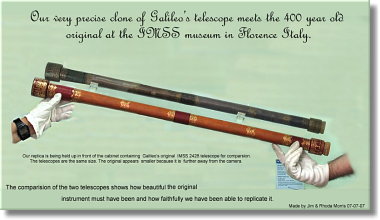
Galileo Telescope with reproduction
|
|
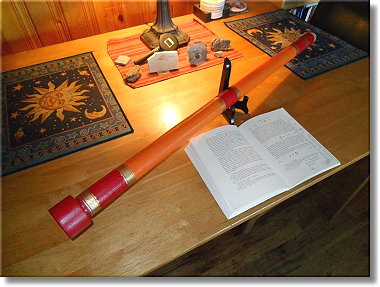
My own Galileo Replica
|
I stopped the objective down to about 25mm and turned both the objective holder and eyepiece holder out of solid oak on my small Sherline lathe.
The tube is made of a series of mailing tubes slipped together with aluminum tubing and covered with (of all things) strapping tape.
The “texture” of the tape seemed just about right and once glued into place made a quite believable wooden tube. I found as many “color” pictures
of his telescopes that I could find and realized almost immediately I could never duplicate the very beautiful delicate details. So I proceeded
to make some stencils to approximate the gold filigree and matched the colors as closely as I could. The current telescopes (displayed in Florence)
are nowhere near as “brightly colored” as my attempt due to their ages but some of the newer replicas (specifically the one built for the Griffith Observatory,
see picture) do sport some very bright colors.
Both the objective holder and eyepiece holder are “slip fits” in the tube and can be adjusted to focus the telescope for both nearby objects and infinity.
My self imposed deadline was January 7th 2010 being the 400th anniversary (to the day) of Galileo’s first observation of Jupiter.
I did have a sort of first light when I turned the telescope to the rooftop vents of the apartment building across the street.
I was pleasantly surprised and quite impressed. Of course the field of view (as stated time and time again) was tiny, indeed like looking trough a soda straw,
but once focused and after getting used to the small FOV the images were quite acceptable. It was time for the acid test.
January 7th 2010, the sky is a deep, deep blue (as usual for an elevation of 7200 feet with little or no pollution) and the temperature is a balmy -13°F.
The time is approximately 18:15 and the Galileo replica is mounted to my Tiltall camera tripod, no doubt a bit sturdier than the one Galileo had to use.
With no finder and a very restricted field of view it took a few minutes to get Jupiter centered in the 22X eyepiece but once found it was one of those indescribable,
truly emotional moments where you feel as if you are reliving history. Jupiter was a ball with no visible features of any kind but a ball, not a point.
With a bit of settling down and tweaking the focus in small increments one-by-one they popped into view.
Tiny, beautiful pinpoints of light, two on the east side and one on the west. My sweet wife and I danced around on the driveway like a couple of kids,
high fiving and taking turns at the eyepiece. What a delight, what a thrill, hello Galileo my friend what a wonderful thing we now share.
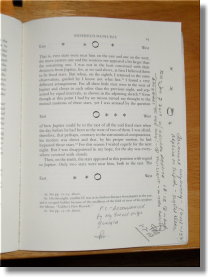
To make things even more interesting, as I logged the observation complete with my own sketch on page 65 of the paperback copy I have of Sidereus Nuncius (see pcture)
I noticed that the positions of the moons in 1610 were nearly identical to those we observed tonight. What a delicious and splendid surprise!
There are things and times that live in our memories always. Births and deaths, anniversaries and milestones but typically not something as simple and personal
as a frigid evening in January, finding yourself standing in Galileo’s sandals looking as if for the first time at an object that until that moment was nothing
more than a moving point of light in the sky.
|
|
|
From then on it would forever be a place, as real as the Earth. What new wonders were to come? What would the other moving points of light reveal? Can you even
imagine what his reaction must have been turning his telescope to our beautiful evening/morning star Venus and seeing for the very first time in the history of
mankind that it was not just a ball but displayed a crescent phase, just like the moon. Can you see him staggering back, reaching for something to hold on to,
his mind attempting to sort out what he was seeing and perhaps even disbelieving what his own eyes had just revealed to him?
Imagine.
Ad astra.
| |