|
About...
THE GEORGIA-RAE OBSERVATORY
by Ray Martin
|
|
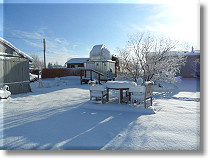
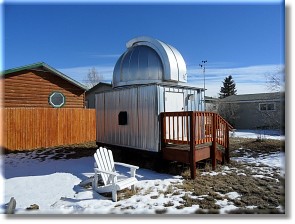
Winter Sunrise at GRO
|
My Observatory and I are dinosaurs.
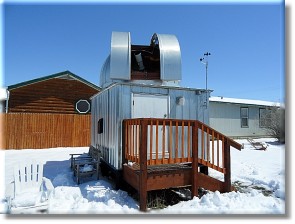
I freely admit it. No excuses, no apologies just a simple fact. We live on the High Plains of Wyoming in the city of Laramie at an elevation of 7200 feet and although GRO does look rather modern with an exterior sheathed in sparkling silver and the roof capped by a 2.5 meter aluminum dome it is only when you step inside that she reveals her true “retro” colors.
|
|
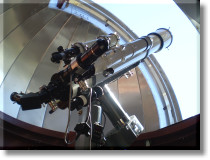
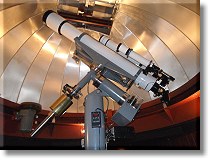
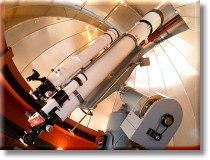
The 6.0” f/10 achromatic
Holland refractor
|
|

"Thank you Henry Wadsworth Longfellow"
|
The pier and mounting are painted “battleship” grey in my own humble tribute to the Hale 200 inch telescope and although the current definition of telescope apertures nearly always refers to them in “meters” the Hale will never be the “5 meter” telescope to me, it was the 200 inch Glass Giant of Palomar when I was growing up and it can never be anything else.
Nearly all of the counterweights and hardware on my mounting are ether polished brass, polished aluminum or stainless steel and the telescope tubes are all painted classic white.
My GEM was designed and built to allow for a battery of telescopes and accessories to be mounted with little or no concern for payload limitations and the drive is a simple AC motor controlled by a now rather obsolete device known as a “drive corrector”. The declination slo-motion is a classic Warner and Swasey type tangent arm and has recently been modified to be fully manual. My mantra has always been to simplify things and I believe this addition certainly qualifies
to be in that category. I think it really looks nice as well.
There are no fast slewing motors or go-to electronics and no computer interface options. The telescopes move at a touch and with such grace and fluidity that the experience of manually pointing them is a joy never diminished by repetition.
The primary instrument is a very rare 6.0” f/10 achromatic refractor made in Holland. The OTA is a precisely machined aluminum tube with a matching dew shield and a perfectly baffled, flat black interior. The tube came to me completely black anodized on the outside but as I stated earlier I am a classicist at heart and refractors, with few exceptions must always be white. So I took it to my friends at the local auto body shop where I knew they had a reputation for very high quality work and asked them if they would do the honors and paint it gloss white.
I was not disappointed, the finish was flawless.
I have visited many observatories over the years, from Palomar to Mt. Wilson from KPNO to Yerkes and for some reason upon entering the dome I nearly always find myself walking more slowly and speaking more quietly as if entering a sanctum sanctorum. My observatory is considerably more humble and the scale considerably smaller but the feeling I have every time I step inside is no less magic.
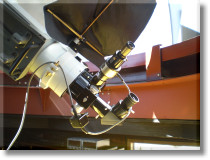
Co-mounted with the 6.0” Holland is a newer 3.1” (80mm) f/11 Vixen refractor set up and used primarily for solar observations. It is equipped with a semi-permanent 75mm ERF and like the Holland is fitted with a Moonlite dual-rate focuser to provide the quite delicate adjustments necessary when observing the sun with the TeleVue 2X powermate and the Daystar 0.7 angstrom H-alpha filter.
An even newer addition to GRO is a LUNT LS-35 H-alpha telescope. Not only does it cosmetically match the Holland, Vixen and Unitron but it provides a “quick look” to help determine if I need to mount up the Daystar filter for a brighter more detailed look at the solar activity. Because it is so lightweight it does not need to be removed even during night time observations and I find it has been a very worthwhile addition to GRO.
The 6.0” can be equipped with a full aperture Baader white light filter and when it is used together with the Vixen the sun can be observed simultaneously in two colors with the same orientation and at nearly identical magnifications allowing me to directly compare the activity in the Photosphere with the H-Alpha image.
|
|
I have assembled a simple sun-shade out of miniature brass tubing, polished aluminum shaft collars and some double sided fabric. The side facing the sun is a bright white and the side facing the observer is a nice dark flat black. The two fabrics are sewn together back-to-back and when the shade is deployed it can be adjusted to shadow the observer in any orientation increasing the contrast in H-alpha viewing and making things far more comfortable by protecting bare skin (and especially bare heads!) from direct sunlight. It is only about 2.0 ft square, very light weight and can be attached or removed in a few seconds.
|
When it came time to equip the Holland with a proper finder I simply wanted more of a classic design that would complement the big refractor rather than one of the newer more compact instruments. In my humble collection of Unitron telescopes I managed to secure one of their 60mm f/8 finders complete with mounting rings and it was the perfect companion. The only modification I had to make was to abandon the 0.965” eyepieces and machine a simple 1.250” adapter. I added a TeleVue 1.250” star diagonal and a 12mm illuminated reticle eyepiece to complete the addition.
To complement my solar observing I designed and built a simple grating spectroscope.
See the GRO Solar Spectroscope on the instrumentation pages...
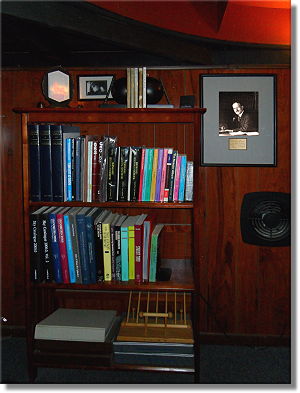
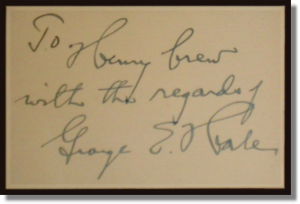
The observatory contains a small library including the classics such as Webb’s Celestial Objects for Common Telescopes, Burnham’s three volume Celestial Handbook, Norton’s Star Atlas (including my very first copy) and Olcott-Mayall’s Fieldbook of the Skies. The modern atlases include Tirion’s Sky Atlas 2000 and a beautiful hard cover three volume set of the Millennium Star Atlas complete with transparent overlays. Occupying the top shelf of my bookcase are the crown jewels of my humble collection, four small original (not reprints) hardcover books written by George Ellery Hale. The titles are, The New Heavens, The Depths of the Universe, Beyond the Milky Way and Signals from the Stars all second editions dating from 1923 to 1931 and all with their dust jackets intact. Accompanying this set of books is a simple small rectangular white card now protected by a glass cover framed with a photograph of Hale in his Yerkes office. Written on that card in blue fountain pen ink is a simple message: “To Henry Crew with the regards of George E Hale”. From 1891 to 1892 Henry Crew was employed at the Lick Observatory where he went, at the request of the Director, to measure the motion in line of
sight (Doppler effect) of certain stars and also to see what could be done in the way of photographing stellar spectra by use of a concave
grating of deep curvature which Mr. Brashear had given him for the purpose. On reaching the observatory, he found himself on
the "no man's land" between two bitter factions. He joined one of these groups (that of S. W. Burnham and E. E. Barnard, his lifelong friends) for one year.
|
|
|
|
|
In keeping with my modest philosophy and resistance to the current digital/imaging revolution the “bridge”
of the GRO has been kept observationally friendly, simple but still warm, efficient and comfortable.
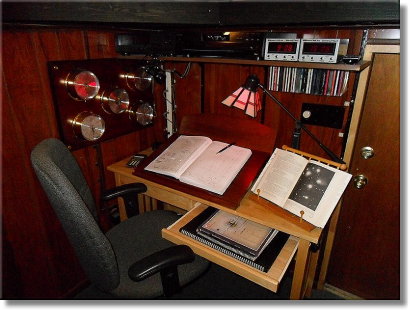
Levenger supplied the dark cherry tilt table that fits the Millennium Star Atlases perfectly and the foldable book stand.
The shelf holds two of the three digital clocks displaying UT and Sidereal time along with the stereo receiver and 5-disc CD changer.
On the wall is the Maximum Weather Station with all analog instruments displaying wind speed and direction, barometric pressure,
outdoor and indoor temperature relative humidity and Mountain time.
|
On the desk just to left of the tilt table is my nearly antique HP-67 calculator, obsolete perhaps
but it can still do any and all math functions that I may require and unlike its newer contemporaries it can easily be read in the dark!
The electrical panel on the back wall (with the small white knob) controls the (red) outdoor porch light,
the interior dimmable indirect red lighting, the three small upturned flood lights (work lights) and the three exhaust fans
to help exchange the interior air during the very warm summer months.
Finally, the observing desk itself was quite a serendipitous find.
I was wandering around our Target store and came across this “Mission” style computer desk complete with pull-out drawer
for the keyboard and a nice “normal” drawer for storing office supplies.
I measured it and to my delight it was *just* the right length to fit between the south wall and the doorway and just deep enough for my Levenger tilt table and book stand.
The “keyboard” drawer was big enough to accommodate the Tirion Sky Atlas 2000 among other larger flat publications and to add icing on the cake I picked it up for $99.00 brand new! What a deal!
I consider myself quite lucky to have found a very rare Hale original autograph and when I think about the fact that the man himself handled that card I like to believe that a little of him is still there and has finally returned to the observatory. Welcome home Dr. Hale.
|
|
|
Finally, to my oldest astronomical acquisition, a very well preserved copy of “Astronomy by Observation” written by Eliza A. Bowen.
The copyright is 1890 and every star map, illustration and diagram is hand drawn and colored, there are no photographs here folks! The only flaw is that the previous owner, an MD from Oklahoma found it necessary to sign every page with his name, yes every page. He did it in the margins so nothing has been written over or lost but it certainly is a distraction.
.
|
|
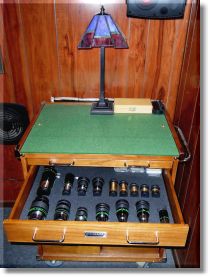
Eyepieces and accessories are comfortably stored
in what I consider one of my “pride and joy” items,
a beautiful Red Oak Gerstner roll-around with green felt drawer liners
and foam drawer inserts to keep everything in place,
organized and relatively dust free.
|
My only “nod” to digital technology (besides my rather antiquated drive corrector) are a trio of red LED clocks displaying UT, Sidereal and Local time, a set of JMI digital setting circles to complement the Magnusson 6.0” polished aluminum beauties that were original equipment on my first Cave mounting, a sound system that includes a CD changer/player and finally my trusty old HP-67 calculator that unlike its newer contemporaries can actually be read in the dark.
But I digress, one quick word about sound systems. When I say “sound system” I don’t mean “boom box” or something strapped to the base ring of the dome or a docking port for an MP-3 player, I mean an actual stereo system with a pair of high quality speakers, a good receiver and CD player. Why? One word: FIDELITY. There are evenings after work and after dinner when the need for some quiet time is required. At these times I pour a snifter of Brandy, grab a few favorite CD’s and head out to GRO. The weather is of no consequence, this is not observing time it is something else entirely. After the door closes behind me, the work lights are turned off and the indirect red lights hidden in the corners are brought up. The red desk lamp is set for a gentle glow and I might even turn on my Maxfield Parrish night light. With the illumination adjusted it’s time for the music. Ralph Von Williams’ “The lark Ascending” or the Cambridge Singers “Brother Sun Sister Moon”, Enya or perhaps some Chant. If I am in the mood for something more contemporary, John Serrie’s “Flight Path” or some New Age solo piano. Whatever it is, the release is magic and if the wind is up or even if it’s raining, the natural sounds just add to the Gestalt of the moment.
So there you have it, certainly a dinosaur by today’s standards with its abject lack of current technology and any kind of imaging system but it fits my needs and wants perfectly.
I have been an astronomer for over fifty years.
After I retired I felt it was time to return to the essence of astronomy, to simple observing with a telescope and a pair of soft warm eyes (Thank you John D).
It was a decision I made gladly, to divest the observatory of any unnecessary distractions or complications to concentrate on observing and just having fun.
Imaging and computers have their places and to those of you who have chosen that path I hope it brings you joy.
My place is at the eyepiece.
Dinosaurs rule!
Ray Martin
Georgia-Rae Observatory
Laramie, Wyoming
Starman9@bresnan.net
|
|
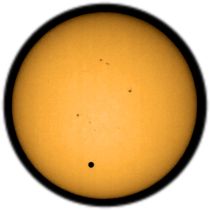
The 2012
Venus Transit
|
|
|
|
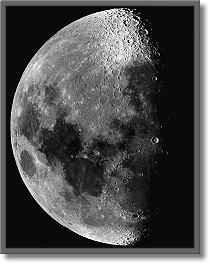
The moon captured
a long time ago on 35mm film
with the GRO 3.0” Unitron refractor
|
| |